Propulsion, First stage, Gimbal
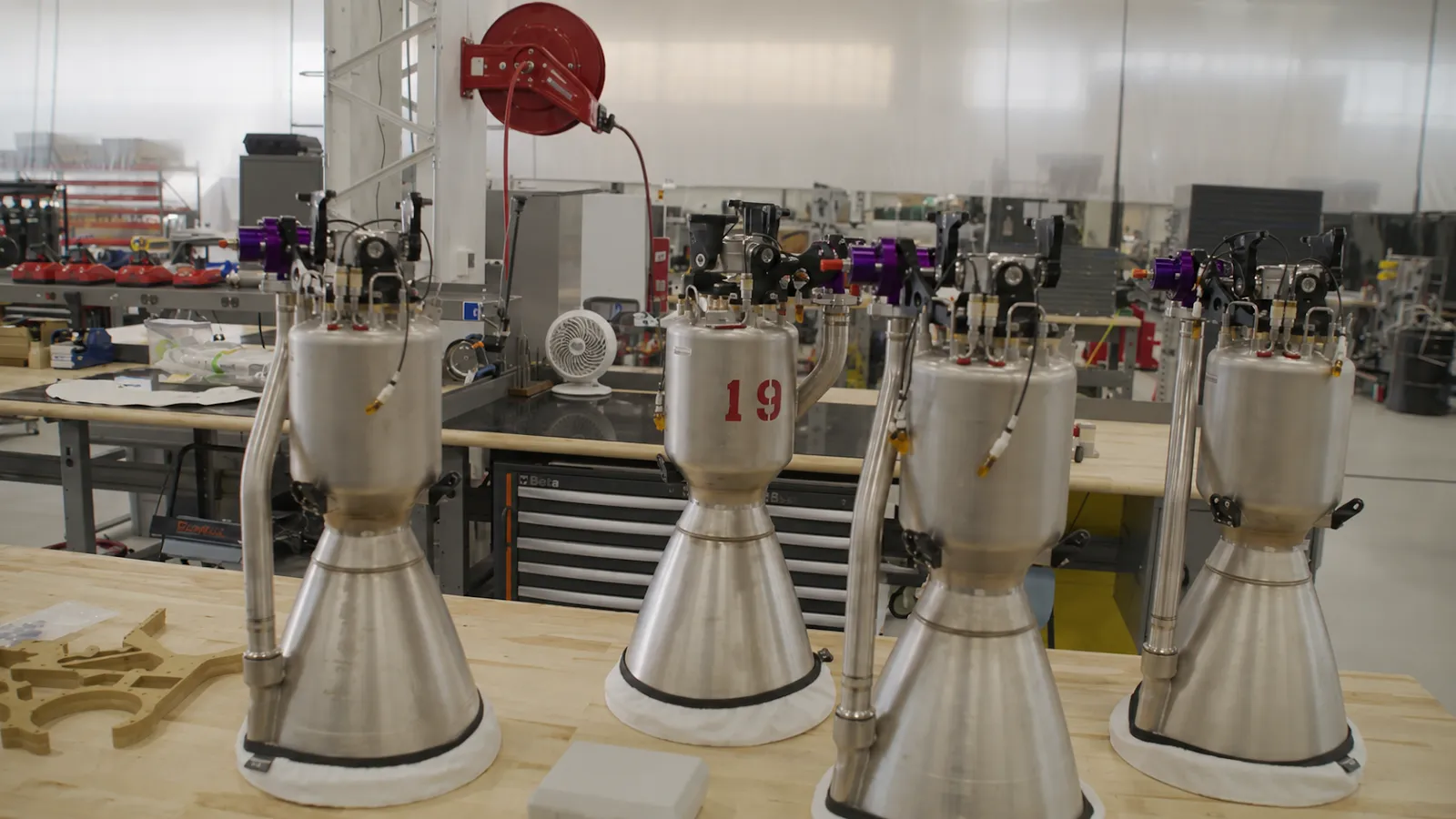
I was given the remit to completely redesign the first-stage engine. About ten configurations later — and after a long fight over a TVCA layout that wasn't 90° — there was a lighter, simpler machine designed around the rocket, not around itself.
Aerospace was quite literally taking off in 2018. SpaceX and Rocket Lab were having fantastic success and other startups were looking to get into the game. Matt Lehman interviewed me, then one by one other folks gave me puzzles to solve and put all kinds of hardware in front of me to look over. I had passed the test with flying colours, so I started work at Astra on Thursday, July 20th, 2018 — the exact day of the first Astra launch, Rocket 1.0. A terribly short-lived flight.
I had spent the last eight years doing engineering with top-tier designers — F1, IndyCar, Cosworth, Ricardo, TRD, HPD — guys with PhDs who were serious about design and had taste. Astra was a different room. I was given the remit to completely redesign the first-stage engine. Chris Kemp came up to me once and said if he could have anyone's job at Astra, it would be mine.
The rocket engine I was tasked to redesign was littered with errors. Propellant always leaked everywhere, in the test cell, and just always as it was run. Some parts had bolt holes in CAD but when they were machined, you literally couldn't put a bolt in — there was no room.
The main fuel line going to the regen manifold was so horribly over-constrained that you had to cut the tube to a precision of ±0.001″ to even get it on, then put B-nuts on it, flare it, and when it was installed the moment the engine warmed up it just wanted to separate from the chamber, because one end of the tube was connected to the hot chamber and the other to the cool fuel pump. No thought at all had been given to thermal expansion.
The engine was unnecessarily heavy because it was designed to resist its own thrust. The engine had a thrust structure, which was then mounted to the thrust structure of the rocket — a redundant bit of mass. The bellows for the propellant lines were off-the-shelf parts that had no business running at the conditions they were operating at, so they blew up all the time, and everyone was afraid of bellows like they were some great mystery. They just needed to be designed correctly.
For all intents I was already in space — because I was damn near operating in a vacuum.
I started to operate on my own. Strangely, when I stopped trying to share with my colleagues the ideas I was having, the friction went away. If you shared something, people threw rocks. If you just invented it and had it made, they'd glance at it and move on. All the stakeholders I had to work with outside my own group were fine — they'd tell me what they needed out of the engine to be on the rocket, what I had to dodge like battery packs, where the propellant lines needed to be. The other groups were professional enough to realize we wanted to help each other.
I probably laid out about ten different engine configurations, toying around with ideas. There were so many things one could try to optimize for — put the bellows on the low-pressure side but deal with the lateral, axial, and angular displacements; mount the pumps sideways so the inlets and outlets of the volutes were more in line with the propellant paths. I tried a lot of things.
One thing seemed to frustrate people for a lot longer than I thought it should. On “heritage” rocket engines, the thrust vector control actuators (TVCAs) are always 90° apart — an x-axis actuator and a y-axis actuator. If you push these around to their extremes you trace out a square. What one cares about is the circle that fits into the square. The engine is gimballing inside the square; the circle is the thrust vector envelope.
My remit was for ±5° of thrust vector actuation. I gave myself room for error and ended up with ±7°. The thing that frustrated folks was that I figured out — while trying to package the engine in a way that didn't impede other stakeholders — that having a 110° angle between the TVCAs was about beautiful. People could not get their heads around it not being 90°.
It was ingrained in the psyche of aerospace I guess, but it wasn't necessary for it to be 90°. I circumscribed the circle I needed to with the throw and mounting locations of the TVCAs — job done. It took a long time to sell that to whoever noticed, and also to avionics, who had to do the math/programming to eventually steer the rocket.
Astra was a study in designing through resistance. The work itself — the act of laying out an engine that respected its real constraints — was the most clarifying part of it. The principles I took with me to Cog crystallized there.