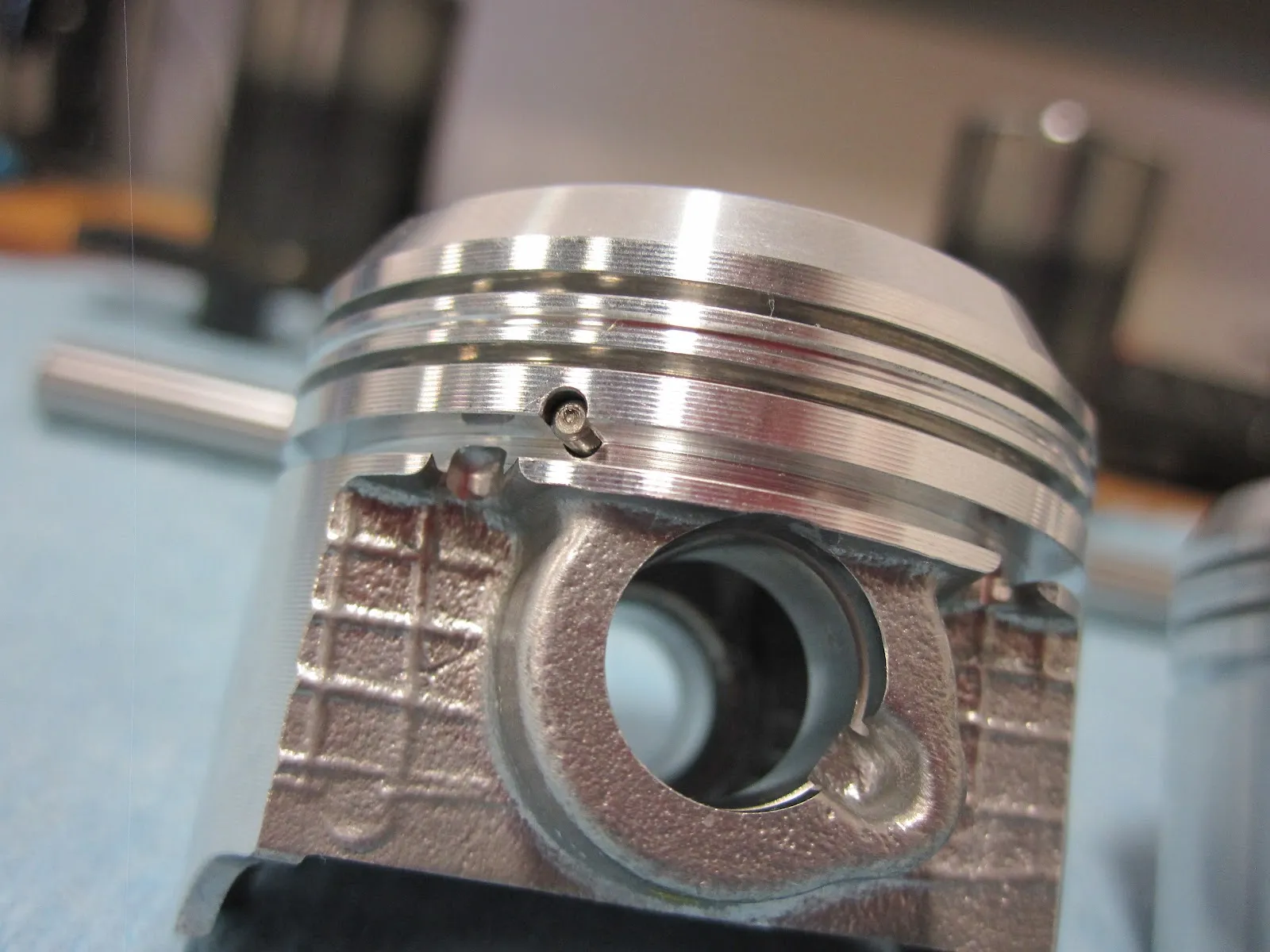
Powertrain, Pistons, Oil control
A small chamfer on the oil-ring land. On a 39 mm piston, it was a large amount of support for a 0.3 mm thick oil rail. No one could ever tell me why it was there — but it was on every piston anyone had ever seen.
I worked at Pinnacle Engines from 2010 to 2018. It was the first real design job that I had, and there we designed bespoke automotive engines — opposed-piston, opposed-cylinder four strokes. I was involved in helping design at least three clean-sheet engines, primarily responsible for the entire valvetrain (sans the actual valve) and the pistons. This story is about a piston I designed.
At one point in my past I had read a book by Jade Gurss called The Beast. It is about the design and development of a very famous Indy Car engine — the 1994 Ilmor 265E. It's a pushrod engine, an inferior architecture to the very superior overhead 4-cam/4-valve engines that dominated the series. The rules changed to encourage people to work with the poor architecture by allowing 25% more displacement and 20% more boost. Ilmor and Penske went for it.
In the chapter called Turning Point, they run the engine and it's way down on power. A valvetrain designer — Jeff Williams — tries to explain to Mario Ilien that the cam is too aggressive and needs to be softened. Mario is the boss and doesn't like it when anyone disagrees with him. Mario left for a ski trip for one week. In that week, Jeff Williams designs and has made a camshaft of his own ideas. They run it, and the engine power jumped from 850 hp to 970 hp.
Well, Pinnacle Engines had an oil-consumption problem. I had literally combed over every dimension of those pistons except for one. Everyone around me was more experienced — we utilized a company that did piston ringpack/gas-dynamics modeling; we had our pistons machined by a company who does micron-level piston profiling; I was surrounded by designers from Cosworth, Ricardo, TRD.
That said, the piston was my problem and I started to suspect one particular feature. No one could ever tell me why it was there, but it was on every piston anyone had ever seen. I heard a lot of educated guesses, and likely they were right, but no designer or consultant could truly say whether it was necessary. I started to suspect — at the scale of our tiny engine — this feature was a problem.
Sometimes innovation just looks like being brave enough to do something that no one else is capable of doing.
I gathered my thoughts and argued we should try a design iteration without this feature. The idea was met with resistance in the face of all these consultants and experienced folks. How could it help? Every piston has them. Well, shortly after we were due for another piston order — and my boss went on vacation — so I made the change and then forgot about it as one does when things get busy.
The testing team came into the office one day elated that the oil consumption problem was completely resolved, and wanted to know if there were any design changes that could have contributed. Then I remembered: pistons E040956 / 57, I had deleted the chamfer on the oil ring land. Our engine had 39 mm pistons, and tiny oil control rings, and I started to realize that a small chamfer was a large amount of support for a 0.3 mm thick oil rail. I deleted it and it solved the problem. We passed on the information and designs to our OEM partner for confirmation, and I received a promotion.
In aerospace there are two words that describe a design — “legacy” and “heritage.” Legacy is what you call a design that no one likes anymore. Heritage is the design that works, and it becomes the benchmark, and no one wants to deviate from it. If you bring heritage with you from your last job — which was big and fancy — all the more difficult to change it.
I am starting to lose count of the clean-sheet projects I've been a part of where — when the world is your oyster and you can design what you will — the prevailing sentiment goes from let's take some risk and do something cool to well, let's go with heritage, and later we'll maybe get risky with it. No one ever goes back. You have to innovate first, be bold, take the risk. Take all the advantages you can early. Design with high idealism — the compromises come fast, so stick to your core tenet, and you'll end up with something really interesting.