Fusion, Optomechanical, SiC
One month to review, redesign, and qualify a mirror assembly for the port plug of a Tokamak. The original was made of metal in a place where metal had no business being. We started over.
I was brought into a meeting to review a mirror design. I had one month to not only review the design but to also show that it could successfully be manufactured and used inside a port plug installed in the Tokamak. The original designer had left the company in a bit of a huff. Some FEA had been done, and the perception in the room was that hopefully it was just going to be a relatively minor operation to dot the i's and cross the t's.
I opened the CAD assembly in NX and had a think about it. It looked like a very incomplete model — all the CAD was very simplistic and there was no design for manufacturability implemented in any of the piece-parts that I could see. It looked terribly complicated. As I learned a little more about opto-mechanical design and started pouring through the PowerPoint presentations that covered the justification for its inception and review, I realized I needed to stop for a second and go back to the beginning. What was this thing supposed to do in the first place?
This mirror is supposed to reflect light from the Tokamak plasma back towards a vacuum ultraviolet (VUV) spectrometer. I first spoke to the responsible physicist to try to understand what it is that he really wanted. He was looking for a very specific band of ultraviolet light. The best possible mirror material, he told me, was CVD-coated silicon carbide. Truth be told I didn't even know what that was, but I noted it and kept asking questions.
I discovered it would be mounted inside a port plug; that the Tokamak is baked to 350 °C for an extended period under vacuum; that the mirror would experience temperatures of around 280 °C during operation. There would be massive electromagnetic fields and some shock in the event of a plasma disruption. That was it.
The mirror I had been evaluating was made of metal — a huge chunky thing, and now I understood why. That metal has a permeability that makes it susceptible to those massive electromagnetic fields, which in turn makes it subject to massive forces. Because the temperatures were so high, the material was also expensive, hard, and difficult to machine. To get the SiC mirror surface, the part would then have to be coated with silicon carbide.
There were sizable fasteners holding it to the port plug, and sophisticated silicon-carbide ball bearings that required virtually unachievable surface finishes to work — a sort of semi-kinematic mount designed to resist the inevitable thermal expansion that 350 °C brings. There was a sad little bent sheet-metal cover that seemed obvious was never going to work.
One must be very comfortable being uncomfortable for extended periods of time before a truly creative idea can manifest itself.
At this point I felt like I had collected all my data — I understood what the mirror was for, the best mirror material, the environment, the desires of the end users. I started to see the ball of complexity surrounding the existing design and wondered if it was a thing that could be fixed. I decided quickly that I wasn't interested in the approach. So then, what would I do different?
This is one of the best parts about design. I had never seen a problem like this before in my life. But I saw the problem, I saw the environment, I saw the desires of the end users. I knew it needed to be manufactured, that somebody needed to be able to assemble it reliably, what the mirror surface should be, where the mirror needed to be and how big. The space claim was tight.
Between the realization of the problem and the solution, there are extended periods of total inactivity — I'm not drawing anything or doing anything in CAD. These times are characterized by long showers, sitting at my dining room table with a cup of Marco Polo tea, walking my dog. It took me three days or so to get out of this mode, and then I worked on proposing what I now perceived to be a solution.
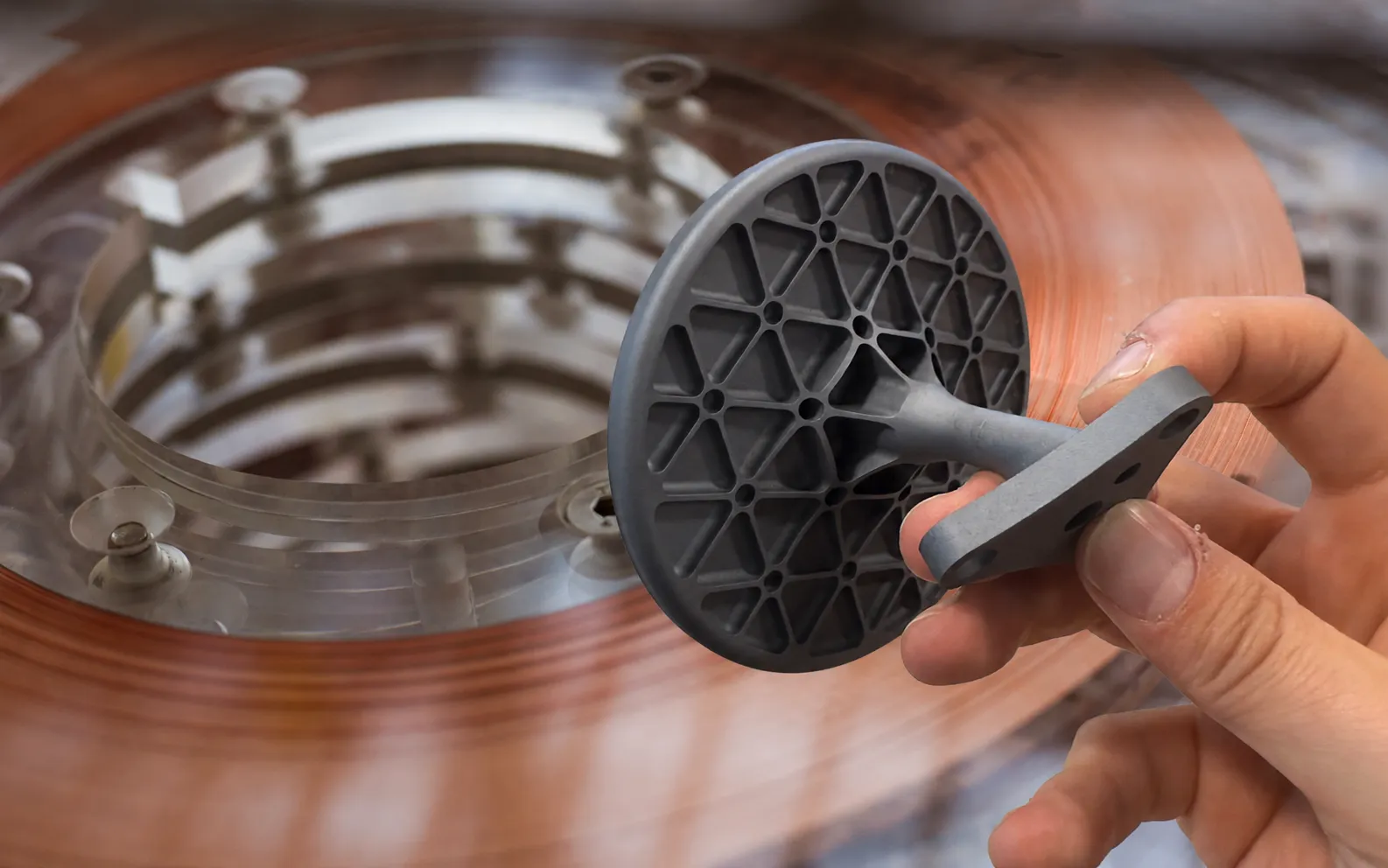
In the face of large electromagnetic fields, and in the face of extremely high temperatures, I proposed to make the entire mirror — the whole assembly — entirely out of silicon carbide. Silicon carbide does not care about heat. Silicon carbide does not see electromagnetic fields, and thus there are no loads on it. And it's already the best material for the mirror — no need to CVD coat anything.
No one could imagine it in that room and in short order the idea was basically dismissed. The room started discussing other types of designs that they had seen work before in other contexts. Honestly it was embarrassing, but I could see that my idea was not going to get a fair shake there, and I felt it deserved one, so I pretended I had a prior engagement and left.
There was one person in that room who I thought might have the temerity to help — an analyst, the one who would be doing any ANSYS work anyway. Immediately after I left, I reached out. When the meeting ended, he called me. I asked what he thought. He basically said he thought it was cool, and I asked if he was interested in helping push the idea forward. He was. It was the perfect pairing.
I would throw a design over the wall, he would analyze it in the port plug, I would try to fix the holes. Wash, rinse, repeat. To this day it is one of the best design experiences I ever had. We came up with a pure silicon-carbide design that met all the requirements — including the structural design requirements with a safety factor of three. We got the best material data we could for that SiC, and we made test samples to convince ourselves we understood the material, doing our own in-house tensile tests alongside MIL-HDBK-17 data.
In one month, I was explaining to the team how I conceived of the design, how the analyst and I iterated back and forth with the silicon-carbide vendor to ensure the design did everything, that it could be made, that it was strong enough. All of it. Shortly after, I received a promotion and a pay raise as a contractor. I was invited to the Commonwealth Fusion Systems employee party and enjoyed a week in Massachusetts meeting a lot of fantastic people — including my analyst friend.
Empathy, curiosity, idealism, and tenacity probably characterize my designs. I never do anything on my own and I always remember what shoulders I'm standing on.